The Birth of the Can
The end of the 18th century was a time of war in Europé. Troops were out for long stretches of time and the armies were faced with a difficult problem; how do we supply our troops with safe and long-lasting food? Without knowing it at the time, that was the question that was to shape the entire future of the canning industry. So how did we really go from a soldier’s meal to global industry?
In 1975, the French government came up with a way to spark interest in the problem in the hopes of finding a solution. They offered a reward for anyone that could come up with a reliable methog of preserving food. The innitiative set of a wave of experiments.
Nicolas Appert, a French candy maker and brewer took to the challange. After 15 years (In 1809) of research and experiments he finally figured out that cooked food sealed in airtight containers would remain edible if properly processed. The process, much similar to how many preserve home cooked food today, was made by partially cooking the food, sealing it in bottles with a cork stopper and immersing the bottles in boiling water. His work, published in 1810, proved the principle of preservation by heat and seal, and laid the groundwork for everything that followed.
Soon after, in 1810, Peter Durand in Britain patented the idea of using metal containers instead of glass. That patent opened the door to tin-plated iron cans. These were tougher, more transportable and much better suited to large-scale distribution than fragile jars. The first commercial cannery opened shortly thereafter, in Bermondsey, and a new industry was born.
From handmade tins to mechanised production
The earliest cans were heavy, handmade and had to be opened with chisels. They may have been effective but they were both difficult to use and expensive. As demand grew through the 19th century, inventors and manufacturers focused on making the process faster and safer. Mechanical advances like cutting, forming and sealing gradually replaced hand labor. By the late 1800s the foundations of modern can manufacturing were in place with standardised ends and bodies, mass production techniques, and a clear need for reliable seals.
The revolution of the Double Seam
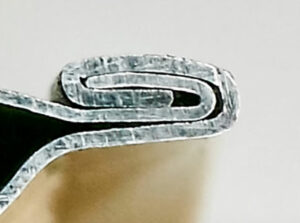
Around the turn of the 20th century a crucial innovation arrived: the double seam. Instead of soldering or adhesive, the double seam mechanically interlocks the can body and the lid by folding metal in two precise operations. This method created a strong and durable seal that could be formed quickly on high-speed lines,
dramatically improving safety, speed and hygiene.
The double seam’s impact was immediate and an invredibly important step towards the canning industry as we know it today. It removed the need for hazardous soldering, allowed higher production speeds, and became the accepted standard for both food and beverage cans. In short, it changed the industry from small scale production into engineering-driven manufacturing.
War, convenience and the spread of canned food
Just like in the 18th century, the military was one of the big drivers of change in the canning industry. During the conflicts of the 1900´s canned food became essential for armies on campaign and the demand increased. That wartime need drove scale and innovation, which in peacetime made canned goods affordable and available to the people in a commercial sence. Urban populations, in need of convenience, embraced canned staples and the can quickly became an everyday essential.
Material and design advances
The 20th century brought two big shifts: materials and form. Steel gave way to lighter aluminium for many beverage applications; two-piece can designs and improved alloys reduced weight and enabled ultra-fast filling lines. These changes didn’t just improve economics but they reduced resource use and supported recycling at scale. Modern aluminium cans are lightweight, robust and among the most recycled consumer packaging types today.
Why seams demand precision
As cans became lighter and production speeds increased, tolerances tightened. What was acceptable in a heavy-walled, slow-made tin won’t do on a line that produces thousands of aluminium cans per minute. Small deviations in cover hook, overlap, seam thickness or seam gap can mean leaks, contamination or product loss. That’s why seam measurement and inspection are critical parts of every production process.
From cutting to cameras: how we inspect seams today
Inspection methods evolved alongside can technology. Traditional destructive testing, cutting seams and measuring them, remains a gold standard for visualising internal geometry. But the industry also moved toward non-destructive and automated techniques: high-resolution vision systems, precision mechanical gauges, and X-ray inspection that reveal internal structure without destroying the can. Modern systems combine speed, repeatability and traceability so manufacturers can monitor quality continuously and act before a defect becomes a recall.
A continuing lineage of engineering
The can’s history is one of applied problem-solving. The practical need that sparked invention and innovation. For companies that build inspection equipment, and for the engineers who run production lines, that history is not academic. It explains why we focus on accuracy, longevity and service. A seam that holds is a seam that protects a brand’s product and reputation. And that is why quality control will always remain central to its future.